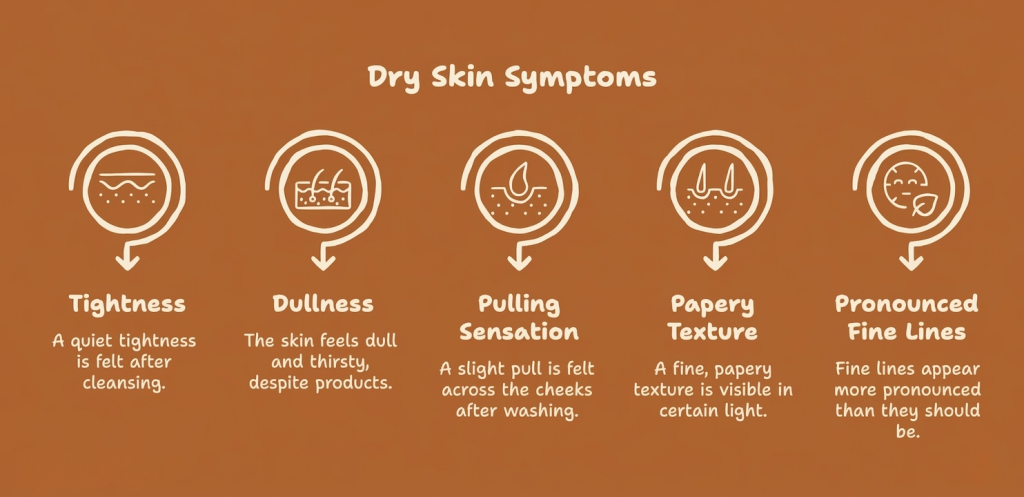
That quiet tightness after cleansing.
The dull, almost thirsty feeling, despite a shelf full of products.
These aren’t just small inconveniences. They are your skin’s way of telling you something deeper is off.
Dry skin carries a particular kind of discomfort. Not always dramatic. Not always visible. But always present. A slight pull across the cheeks after washing. A fine, papery texture in certain light. Fine lines that seem more pronounced than they should be.
So you reach for more. Another serum. A richer cream. A new routine.
And yet, the feeling stays.
Because more often than not, this isn’t a product problem. It is a skin barrier problem.
Dry skin, clinically known as xerosis, isn’t just a “skin type.” It is a state of vulnerability. When your skin loses its ability to hold on to what it needs, everything shifts. How it feels, how it looks, how it reacts, even how it responds to the products meant to help it.
The Architecture: What’s actually happening beneath the surface
Think of healthy skin like a wall.
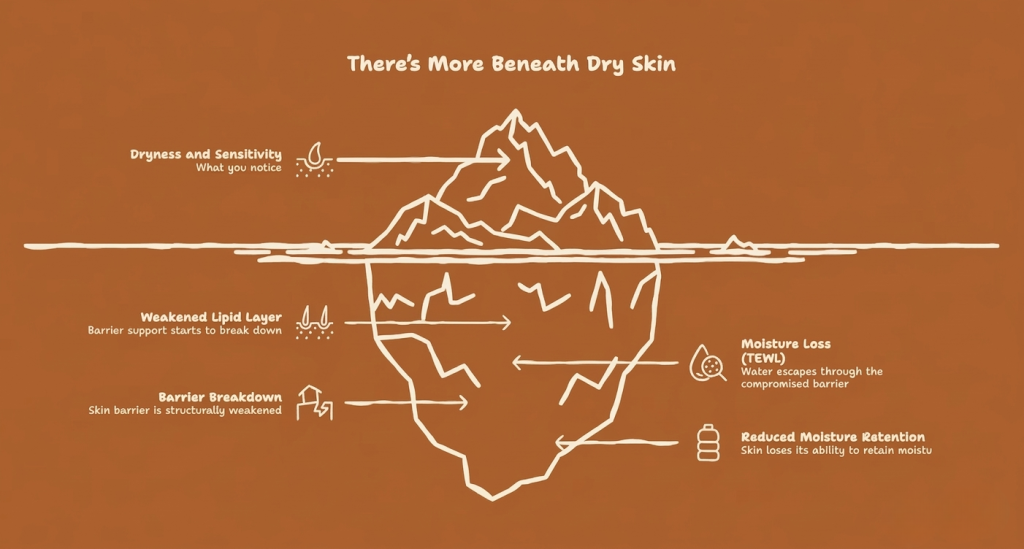
Skin cells are the bricks. Lipids such as ceramides, fatty acids, and natural oils act as the mortar holding everything together.
When this structure is intact, it does two things effortlessly. It keeps moisture in and irritants out, maintaining overall skin hydration and skin health.
But when that lipid layer starts to weaken, the wall begins to break down.
Water escapes through a process called Transepidermal Water Loss (TEWL).
And suddenly, the skin becomes more reactive, more fragile, and more prone to dryness and sensitivity.
What follows feels familiar. Tightness, flaking, sensitivity, and a dullness that no highlighter can quite fix.
A compromised skin barrier isn’t just cosmetic. It is structural.
Dryness isn’t just a lack of moisture. It is the skin losing its ability to retain hydration effectively.
Understanding the Triggers: Internal and External Factors
Barrier damage rarely comes from one single cause. It is usually a combination of small, everyday factors that build up over time.
Environment
Cold air, low humidity, and seasonal changes reduce the moisture reaching your skin. Even everyday environments like air-conditioned rooms and long commutes quietly pull hydration away, contributing to dry and dehydrated skin.
Over-cleansing and harsh products
Hot water and strong cleansers strip away natural oils that help lock in moisture. This weakens the skin barrier function, especially when done repeatedly.
Product overload
Layering too many activities can overwhelm the skin. Without time to recover, the barrier weakens instead of improving, often leading to increased skin sensitivity.
Biology and time
As we age, oil production slows down. Collagen and elastin reduce. Natural moisturising factors decline. These changes are natural, but they make consistent skin barrier repair more important.
It is also important to understand the difference between dry skin and dehydrated skin.
Dry skin lacks oil.
Dehydrated skin lacks water.
Dehydration can affect any skin type and often needs both internal care, like hydration and omega-rich foods, and external support through the right hydrating skincare routine.
Reading the Signals: Knowing your skin
Dry skin does not always appear suddenly. It builds gradually.
A little tightness becomes constant discomfort.
A slight roughness turns into visible flaking.
Some signs are easy to miss until they become persistent:
- Tightness after cleansing, even with gentle products
- Fine lines appearing more pronounced
- A dull, uneven complexion that does not respond to brightening
- Stinging or itching when applying skincare products
- Flaking or rough texture in certain light
- Redness or unexpected sensitivity
- A constant feeling of “thirst” in your skin
That last one is especially important.
If your skin keeps absorbing products but never feels hydrated, the concern is not what you are applying, it is whether your skin can retain that moisture at all.
The Restoration: A considered approach to recovery
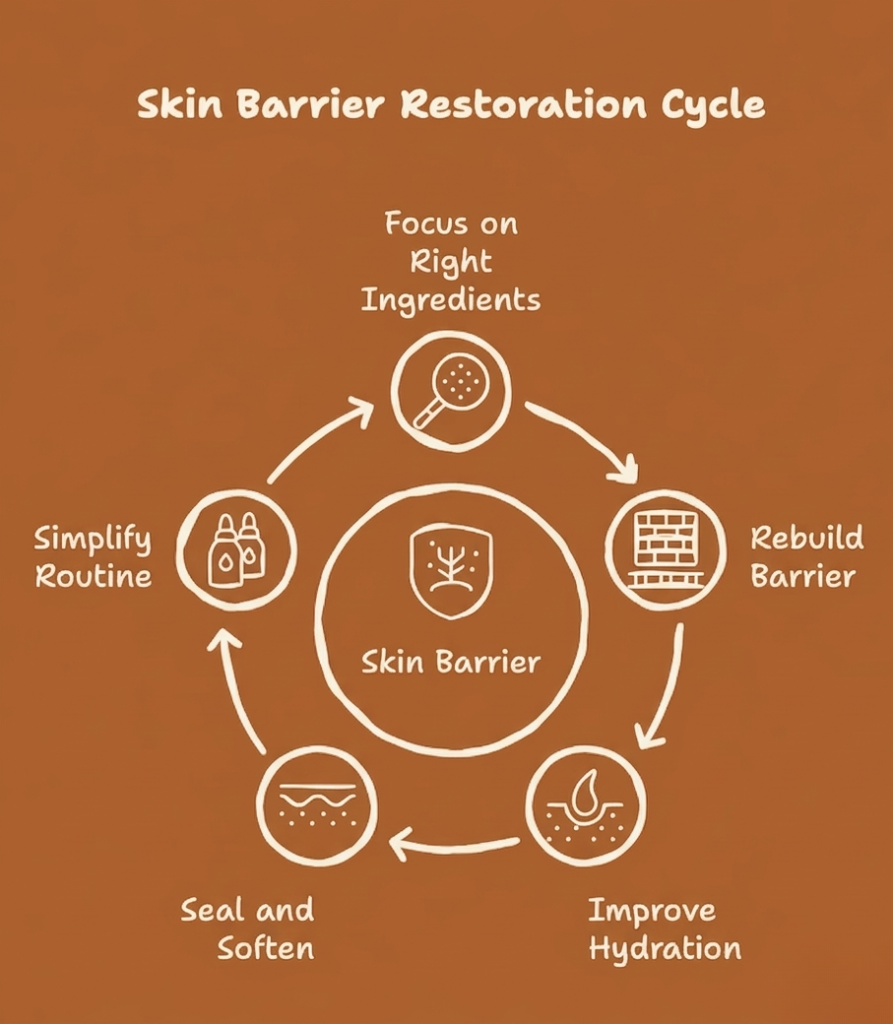
Repairing a compromised skin barrier is not about doing more. It is about doing the right things, consistently.
Focus on ingredients your skin already understands and responds to:
- Ceramides and fatty acids to rebuild the barrier
- Humectants like glycerin and aloe vera to improve skin hydration
- Emollients like shea butter and plant oils to seal and soften
Simplifying your routine allows the skin to reset and recover. A gentle cleanser, a deeply nourishing moisturiser, and one supportive step can often do more than an overloaded routine.
To bring this cycle into your daily ritual, we created a range of products designed to support a resilient skin barrier.
For daily care, the NMantra Bellevue Face & Body Cream offers a well-balanced approach to deep skin moisturisation and barrier repair. Formulated with organic olive oil and coconut oil, along with rich emollients like shea and cocoa butter, it works to soften the skin while reinforcing its natural lipid structure. Aloe vera and vegetable glycerin add a hydrating layer, helping the skin draw in and retain moisture throughout the day. The result is skin that feels not just softer on the surface, but stronger and more resilient over time.
For those who prefer a lighter texture, especially in warmer climates or during the day, the Bellevue Face & Body Lotion provides effective lightweight hydration for dry skin. Built on nourishing oils like sesame and almond, it absorbs quickly without leaving a heavy residue, making it ideal for maintaining hydration without compromising comfort.products designed to minimize the risk of allergic reactions by using ingredients that are less likely to irritate sensitive skin.
When the skin feels particularly reactive, whether due to environmental stress, overuse of actives, or underlying sensitivity, the Bellevue Intense Moisturising Cream offers targeted support. It not only calms visible redness and irritation but also works at a deeper level to restore stability to the skin barrier, making it a reliable option for sensitive and dry skin care.
A small but impactful shift can also make a difference.
Apply your moisturiser to slightly damp skin, immediately after cleansing.
Humectants work by drawing in water. When applied to damp skin, they are far more effective at improving hydration levels and supporting long-term moisture retention.
At night, when the skin’s natural repair processes are most active, incorporating a facial oil can enhance recovery. The Bellevue Facial Oil, with ingredients like jojoba, rosehip, evening primrose, and pomegranate oil, provides essential fatty acids that support skin barrier repair and nourishment. It absorbs well without heaviness, making it suitable even for those who prefer a non-greasy finish.
The Long View: Skin health is a practice, not a purchase
A damaged skin barrier does not repair overnight.
What truly works is consistency. Gentle care. The right ingredients. And giving your skin the time it needs to restore balance.
Most of the time, your skin is not asking for more.
It is asking for better.
A simple, well-structured routine will always outperform a complicated one done inconsistently.
Because healthy skin is not built in a day. It is built through daily care.
Skin health is not a one-time fix.
It is an ongoing relationship.
– NMantra Bellevue 🌿